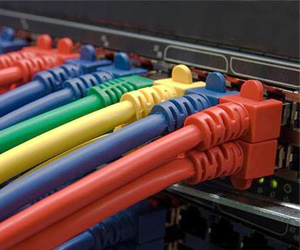
STRUCTURAL CABLING
We provide brand-independent technical solutions to meet all of our customers' needs in structured cabling. Our structured cabling projects offer horizontal cabling, building backbone, and campus backbone cabling services using CAT5e, CAT6 copper, and fiber optic cables. The installed cabling systems create infrastructure systems operating at speeds of 10/100/1000 Mbit/ps. Within our structured cabling projects, data, telephone, security, network, and UPS systems are installed as integrated structures that work together harmoniously. These systems can be expanded together, thus ensuring the future flexibility needs of businesses. We collaborate with leading manufacturers such as XP, LEGRAND, HCS, CORNING, and AMP in our cabling solutions, which offer performance guarantees of 15, 20, and 25 years depending on the manufacturer. After installation, data cables are tested end-to-end, and the test reports, detailed project drawings, cable tracing diagrams, etc., are delivered to our customers.
CORRECT DESIGN
In network systems, correctly designed and implemented structured cabling provides an efficient, fast, secure, and uninterrupted working environment. Furthermore, structured cabling systems are the longest-lasting component of the network system on which critical business applications run. No other element of network systems is used as long as the cabling infrastructure. While this crucial cabling infrastructure constitutes 20% of organizations' total network investments, 80% of the network problems we encounter are rooted in incorrectly designed and implemented cabling systems. Our structured cabling system, a vital communication platform for a business, involves important processes that require continuous monitoring from design to installation. In our projects, solutions are offered using copper cables such as UTP (Unshielded Twisted Pair) CAT5e, CAT6, CAT7 or shielded type STP (Shielded Twisted Pair) STP, S/STP, FTP, depending on the environmental needs determined through site surveys. At the same time, considering distance, security, high bandwidth, and electromagnetic conditions in the project, fiber optic cables offer the best solution. For indoor and outdoor applications, the appropriate cable type is determined from among multimode and singlemode cables, based on the number of cores and components.
It is used in various applications such as between aggregation centers, between floors (shafts), backbone between buildings, campus backbone, metropolitan area, or from switch to desk.
CORRECT WORKMANSHIP
The most important factor that will directly and positively or negatively affect a well-done structured cabling project and design is the workmanship. The quality of workmanship will make itself felt in the performance of your network. Since the quality of workmanship directly refers to the quality of the cabling infrastructure, even the use of very high-quality and well-chosen branded products cannot positively affect poor workmanship.
The data cabling project includes laying copper or fiber optic cables, installing conduits, connecting sockets and patch panels, as well as mounting and installing cabinets. It also involves performance testing of the laid and terminated lines, obtaining test results, labeling the socket and patch panel sides of the lines, and recording this information on the project plans.